

Stop Blaming the Bat
Product Managers Don’t Need More Tricks. They Need Durable Habits.

The “must-have” AI tools changed. Again. Guess what? They’ll change again. Product Managers don’t need more tricks. They need durable habits.
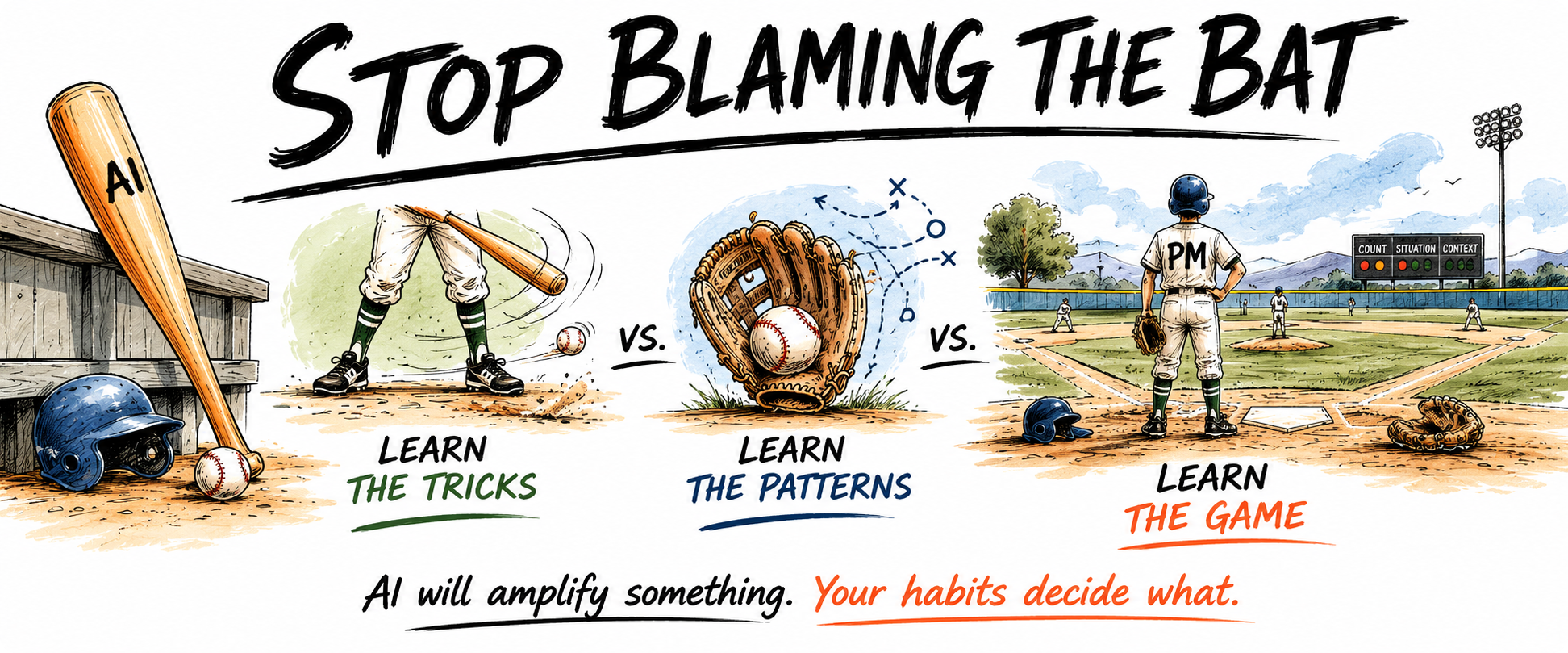
Somewhere in my little league years, there was always that kid.
Not the kid who was scared of the ball and praying silently in right field, where coaches often placed small children to contemplate dandelions, mortality, and whether the inning would ever end.
I mean that kid.
The know-it-all.
The dugout lawyer.
The kid who could quote batting averages, explain obscure rules, correct the coach just loudly enough to be heard, and recite baseball card statistics with the solemn authority of a tiny municipal judge. He knew who led the league in RBIs. He knew which major leaguer choked up with two strikes. He knew the infield fly rule, or at least enough of its foggy outer doctrine to make the rest of us wish we had taken up bowling, chess, or light taxidermy.
And one Saturday, he showed up with a birthday present.
A Louisville Slugger.
Not just a bat.
A Louisville-By-God Slugger.
Finely turned ash. Fresh varnish. Smooth barrel. Clean label. The sort of object that did not merely lean against the chain-link fence, but glowed there, radiating status, possibility, and the faint suggestion that Cooperstown had been notified.
The rest of us had whatever our parents could afford, borrow, find in a garage, or remember to throw in the trunk ten minutes before the game. Sometimes that meant a perfectly decent bat with someone else’s name written on masking tape near the knob. Sometimes it meant a suspicious off-brand club from the bargain aisle, technically shaped like sporting equipment but spiritually closer to a table leg with seasonal ambition.
But his bat was the real thing.
And he made sure we knew it.
He carried it like a relic. He leaned it against the dugout fence with ceremony. He picked it up with ceremony. He took practice swings with the grave self-regard of a boy auditioning for a Ken Burns documentary that did not yet exist. By the time he stepped into the box, every kid within earshot had received the message: greatness had arrived, varnished, branded, birthday-funded, and insufferable.
Then he struck out.
Not heroically.
Not after fouling off six pitches and battling like a tiny gladiator under a July sun.
Three pitches.
Three strikes.
He sulked back to the dugout glaring at that beautiful bat like it had betrayed the family.
Second at-bat, same opera, different inning. Third at-bat, the count went bad so quickly the dust barely had time to settle around his cleats before he was trudging back again, wounded and furious, staring at that finely turned fraxinus as if it had opened a trapdoor under the strike zone and pushed him in.
I remember the look more than the strikeouts.
That wounded accusation.
That private prosecution.
That small-boy certainty that the equipment had failed to uphold its end of the bargain. As if birthday presents were supposed to arrive bundled with hip rotation, pitch recognition, hand-eye coordination, and the good sense not to swing at something bouncing toward the next county.
From the bench came the curmudgeon wisdom of every coach, father, uncle, and sunburned baseball philosopher of that era:
“It’s not the bat, dummy. It’s your fundamentals.”
Only they said it with more color.
A lot more color.
Prompt Proficiency: Learned the Tricks
To be clear, I was not the best athlete on the field.
Not close.
I was not the kid coaches whispered about while pretending not to whisper. I was not the natural. I was not the one whose throw made fathers stop mid-conversation and say, “Well, would you look at that.” I was usually trying to be useful, which is a different skill and, frankly, a more durable one.
There is a kind of player who gets on the field not because the gods of sport placed a golden hand on his shoulder, but because he can be trusted not to turn ordinary situations into insurance paperwork. That was closer to my lane. I was not there to hit the ball into the next zip code. I was there to get the bat on the ball, move a runner, cover the bag, back up the throw, and make sure the routine play did not become a traveling circus with cleats.
Eventually, that made me useful.
A consistent contact hitter.
A reliable utility infielder.
Supporting cast.
Not the star under the lights, but the guy who helped the star stay under the lights because somebody else remembered where to stand when the ball went somewhere inconvenient.
That may not sound heroic.
Good.
Most useful work doesn’t.
My father coached hard about that sort of thing. Not the cinematic parts. Not the glory parts. The boring parts. Footwork. Stance. Grip. Throwing motion. Keeping your head down. Knowing where the play was before the ball found you. Making the routine play routine.
Over and over.
Then again.
Then again after that, usually with the tone of a man who believed Western civilization might yet be saved if one child learned to move his feet before throwing across the diamond.
At first, fundamentals feel beneath you. Then they feel repetitive. Then they feel boring. Then one day the ball takes a bad hop, the sun gets in your eyes, your glove feels wrong, the runner is moving, everybody is yelling, and your feet are already where they need to be before your brain can convene a committee.
That is when fundamentals stop being lessons.
They become habits. Muscle memory.
Early 2023 was the AI version of that first birthday bat. ChatGPT showed up in public like a Louisville Slugger leaning against the fence. Claude followed. The rest of us gathered around the dugout, poked at the thing, took a few practice swings, and started believing maybe this time the gear really could change the game.
And it did.
A little.
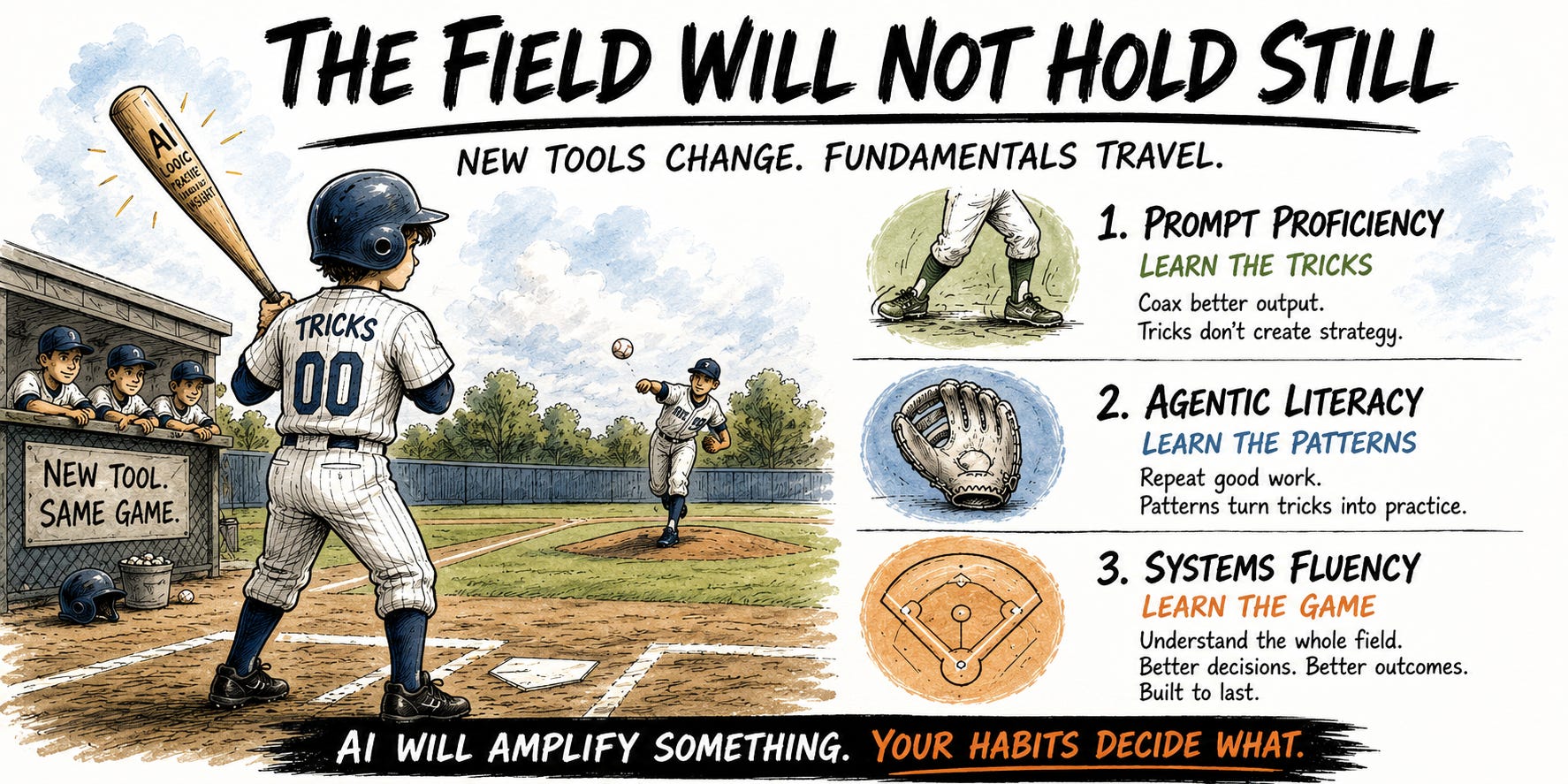
Product Managers learned tricks because tricks were the first available handle. “Act as…” “Think step by step…” “Use this format…” “Make it executive-ready…” “Give me ten ideas…” Some of it worked, and pretending otherwise would be snobbery wearing a cardigan. Prompt Proficiency mattered. We needed to learn how language shaped output, how specificity changed results, how vague prompts produced vague sludge, and how confident prose could walk into a room sounding like a senior consultant while quietly making things up with the moral certainty of a raccoon in a pantry.
That was useful learning.
Necessary learning.
But a lot of Product Managers learned the bat rather than the swing. They learned how to coax output, not how to frame the problem. They learned how to generate user stories, not how to know whether those stories reflected actual end-user goals, constraints, evidence, or pain. They learned how to produce a roadmap-shaped object, not how to decide whether the roadmap had any business existing.
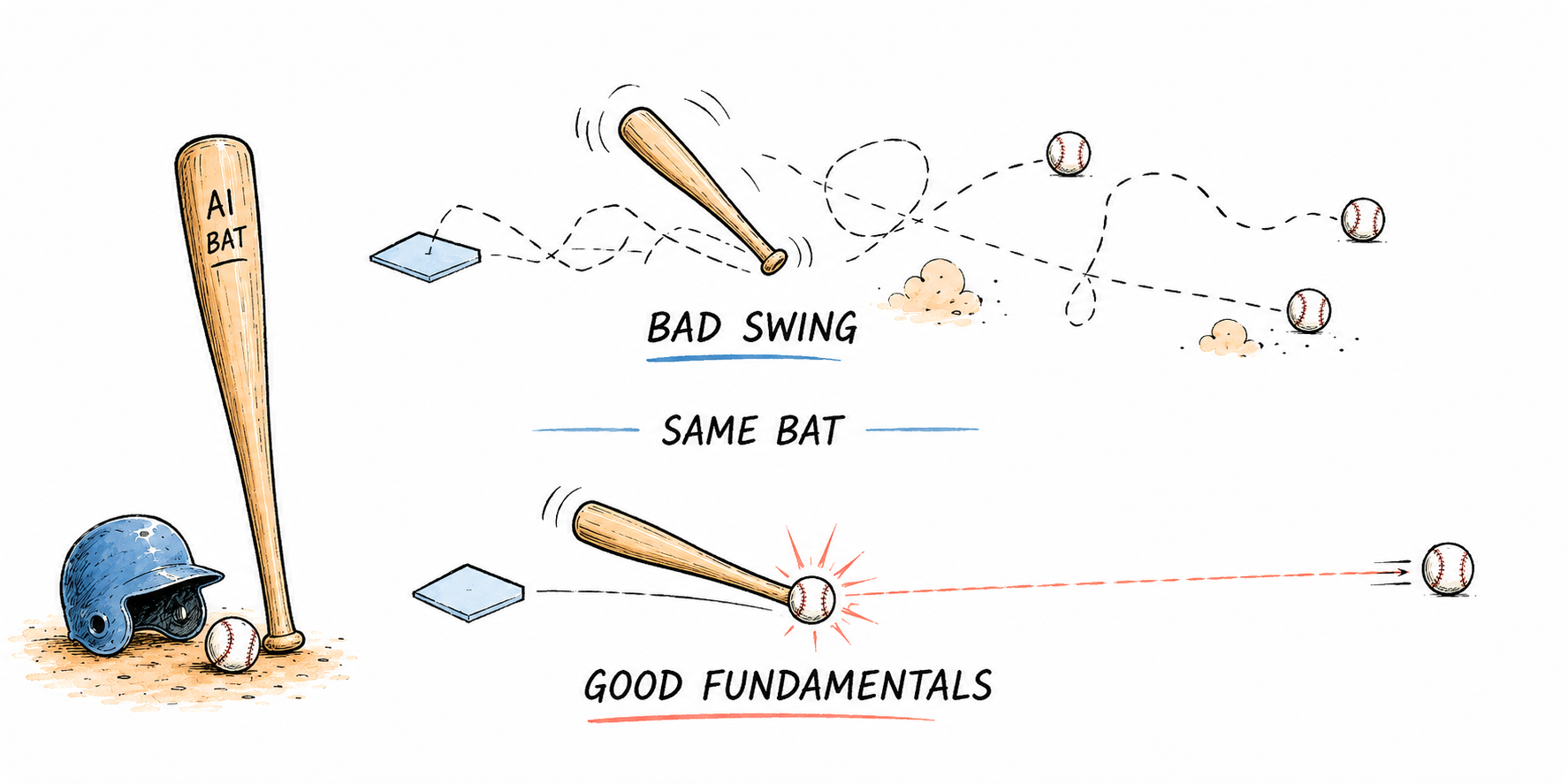
Because a great bat does not fix a bad swing.
It amplifies it.
If your fundamentals are bad, the shiny new equipment just gives your bad habits more exit velocity. You do not merely miss. You miss louder, faster, and with a receipt. The same is true with AI. A good model will not save shallow thinking. It will scale it. It will polish it. It will turn your vague prompt, lazy framing, and half-digested strategy into something that looks crisp enough to fool a room full of exhausted people on their fourth meeting of the day.
The trick was never useless.
It was just not the game.
A million users in five days proves everyone loves a new bat, until they have to swing at a 97mph split-finger slider.
Agentic Literacy: Learned the Patterns
As I got older, the equipment changed.
Aluminum bats started showing up.
Different weight. Different sound. Different sting in the hands. No crack, just that sharp metallic ping that made every father over forty look like civilization had been personally vandalized.
And sure enough, some of the same kids who complained about wooden bats now complained about aluminum. Then the glove. Then the cleats. Then the uniform. Then the field. Then the wet grass. Then the position change. Then the fact that second base “felt weird today,” which remains one of the greatest courtroom defenses ever offered by a child who missed a grounder.
By then I was starting to see the pattern.
Some people were only good when the conditions were just so.
Same bat. Same field. Same position. Same weather. Same rhythm. Same everything. Change one thing and the whole operation collapsed into dust, grievance, and Capri Sun.
They had learned the surface of the game: the gear, the stats, the rules, the rituals, the posture. But they had not learned the game deeply enough to adapt.
That distinction followed me into music, where I competed to sing opera against people who were better musicians, better sight-readers, better pianists, better everything on paper. Some had cleaner training. Some had prettier instruments. Some walked into a room and made the rest of us suddenly aware of our jaw tension.
Again, I was not usually the hero.
Never the lover. Rarely the glowing prince wandering in from stage left with cheekbones, destiny, and a tenor high note sharp enough to cut glass.
I was more often the supporting principal: the comic, the villain, the schemer, the blustery uncle, the guy who entered with timing, turned the scene, kept the show moving, and made the person in the spotlight shine brighter because the machinery around them did not fall apart.
Not because I couldn’t be the bel canto, but because I relished the role of the catalyst.
I learned to win differently.
Breath. Placement. Diction. Support. Phrasing. Preparation. Discipline.
Not magic.
Fundamentals.
By late 2024, AI had its aluminum-bat moment. The tools were not just chatboxes anymore. They had persistence, Projects, Custom GPTs, shared instructions, longer context, reasoning models, and flow tools like n8n and Langflow. The work started to look less like a conversation with a clever autocomplete box and more like a relay race through a warehouse where context had to be handed from station to station without getting dropped, mislabeled, overstuffed, or sent to Legal wearing a fake mustache.
The question was no longer, “Can I get one decent answer?”
That was batting practice.
The better question became, “Can this product team repeat good work?” Has it become part of their mental muscle memory?
That required Agentic Literacy, which sounds fancier than it is. It meant learning the patterns underneath the tools: how context travels, how tasks decompose, how agents move from step to step, how handoffs happen, where evidence enters, where judgment interrupts, and where the machine needs to stop before it turns a helpful draft into a tiny autonomous liability with a login screen.
A trick says, “Here is the magic phrase that worked for me once under perfect conditions.” A pattern says, “Here is the context, the role, the task boundary, the evidence, the handoff, the review point, and the part where a human being still has to decide whether this thing deserves to live.”
That is the difference between the kid who can hit one pitch in a cage and the player who understands the count, the pitcher, the field, the situation, and whether the runner on second has enough speed to matter.
And this is where the amplifier matters.
A high-end mitt does not teach you footwork. It does not teach you where to stand, when to charge, when to eat the ball, or how to make the second throw before the first one has even landed in your glove. But if your fundamentals are sound, a better glove helps you make plays you might not otherwise make.
AI is the same.
If your product practice is a mess, AI will not rescue it. It will make the mess faster, prettier, and easier to distribute. If your product practice is sound, AI can amplify it in ways that feel almost unfair. Not because the tool replaced the work, but because the tool helped carry the weight of the parts that should never have consumed so much of your attention in the first place.
It can assist.
Accelerate.
Augment.
Amplify.
But only if there is something worth amplifying.
Agentic Literacy moved Product Managers from clever individual prompting to patterned product team practice.
Not one prompt.
A repeatable motion.
Not one lucky swing.
A stance, a rhythm, a way of seeing the pitch before flailing at it with a birthday present.
Systems Fluency: Learned the Game
The same lesson followed me into technology, where every few years the industry burst through the door wearing a new costume and announced that everything before lunch had been rendered obsolete. Mainframes, client-server, the web, XML, mobile, cloud, analytics, Agile, search, natural language processing, machine learning, deep learning, neural networks, data platforms, APIs, DevOps, continuous testing, languages, frameworks, databases, stacks, architectures, platforms, and products all marched past like a forty-year parade of expensive disruption with conference lanyards.
Every wave came with its own birthday bat.
Every wave came with people who knew the vocabulary first and the fundamentals never.
Every wave punished the brittle.
Large language models did not invent disruption. They made it inexpensive, ubiquitous, and weirdly fun. That last part matters. AI did not arrive like some grim enterprise platform with a twelve-month implementation plan, a steering committee, and a vendor who says “journey” too much. It arrived like a toy: a box, a prompt, a blinking cursor, a dare.
Ask it anything. Make it write a poem. Summarize a meeting. Draft a user story. Explain Kubernetes to a golden retriever. Build a prototype. Generate code. Rewrite your resume. Produce a strategy doc so plausible it should probably be held overnight for questioning.
It was fun.
That is why it spread.
Now, by mid-2026, the field is bigger again. We are not just drafting. We are building. Claude Code, Codex, Lovable, Base44, agentic workflows, AI-assisted research, AI-assisted prototypes, AI-assisted delivery, AI-assisted documentation, AI-assisted everything, because apparently no noun is safe anymore.
And the workplace around us is not exactly calm. Layoffs, reorgs, budget pressure, AI-first mandates, board anxiety, and executives asking what roles can be “augmented,” which is sometimes a sincere productivity question and sometimes a cost-cutting sentence wearing a nicer shirt.
Whether AI is actually to blame for every layoff does not matter as much as people think. The disruption is real either way. The fear is real. The pressure is real. The need for resilience is real.
And resilience does not come from memorizing the tool of the month.
It comes from Systems Fluency.
For Product Managers, Systems Fluency means understanding the work beneath the work: problem framing, context design, judgment, evidence, workflow design, evaluation, and governance. It means asking what we are solving, for whom, and why it matters before the model starts singing. It means knowing what the AI needs to know, what it should ignore, where that context lives, what source material grounds the answer, how we test the output before it becomes strategy theater, and who owns the blast radius when the clever thing gets confidently wrong.
This is also where the productivity trap shows up wearing a whistle.
If you chase efficiency directly, you will take your eye off the ball. Goodhart’s law warned us about this: when the measure becomes the target, the measure stops being useful. Chase speed, and people will produce faster. Chase output, and people will produce more. Chase cheaper delivery, and people will find ways to make things look delivered.
None of that means you built the right thing.
The better aim is not efficiency first.
The better aim is amplified fundamentals.
Use AI to learn faster, frame better, inspect more carefully, test more cheaply, compare options, surface assumptions, rehearse decisions, expose weak logic, and help the product team return its attention to the work that actually matters. When those fundamentals improve, productivity and efficiency show up as earned side effects. Not as the god being worshiped. Not as the scoreboard being gamed. As residue from better play.
Because building the wrong thing fast and cheap is not strategy.
It is waste with a stopwatch.
These are not tips.
They are not tricks.
They are footwork.
They are breath support.
They are scales.
They are knowing where to throw the ball before it gets hit to you.
The Field Will Not Hold Still
The tools will keep changing.
Of course they will.
The market rewards novelty, the vendors need growth, the investors need a story, and half the internet needs something new to call “the end of product management” before breakfast. Fine. Use the tools. Learn the tools. Play with the tools. Break the tools.
But do not build your professional identity around the bat.
Build it around the fundamentals.
That is what kept me on the field when I was not the best athlete. That is what kept me competitive in music when I was not always the best musician. That is what kept me relevant in technology across forty years of platform shifts, language churn, data explosions, and innovation waves that kept arriving with the calm, measured dignity of a marching band falling down stairs.
And maybe that is why I have spent so much of my career in the supporting cast that makes the star shine. The contact hitter. The utility infielder. The supporting principal. The comic. The villain. The technologist who can move between domains, translate between worlds, anticipate the next play, and help the product team keep continuity because the fundamentals are already in the hands, feet, breath, and bones.
That may not be as glamorous as being the birthday-bat kid.
It is more useful.
Especially now.
Not because AI is hype.
Because it is not.
Not because the tools do not matter.
Because they do.
But because the people who stay useful through disruption are rarely the ones who memorized the newest label first. They are the ones who can make the play when the field changes.
AI will amplify something.
Your habits decide what.
Stop blaming the bat.
Learn the game.
Make the fundamentals habits. Muscle memory.
That is how you stay useful when the next pitch moves.